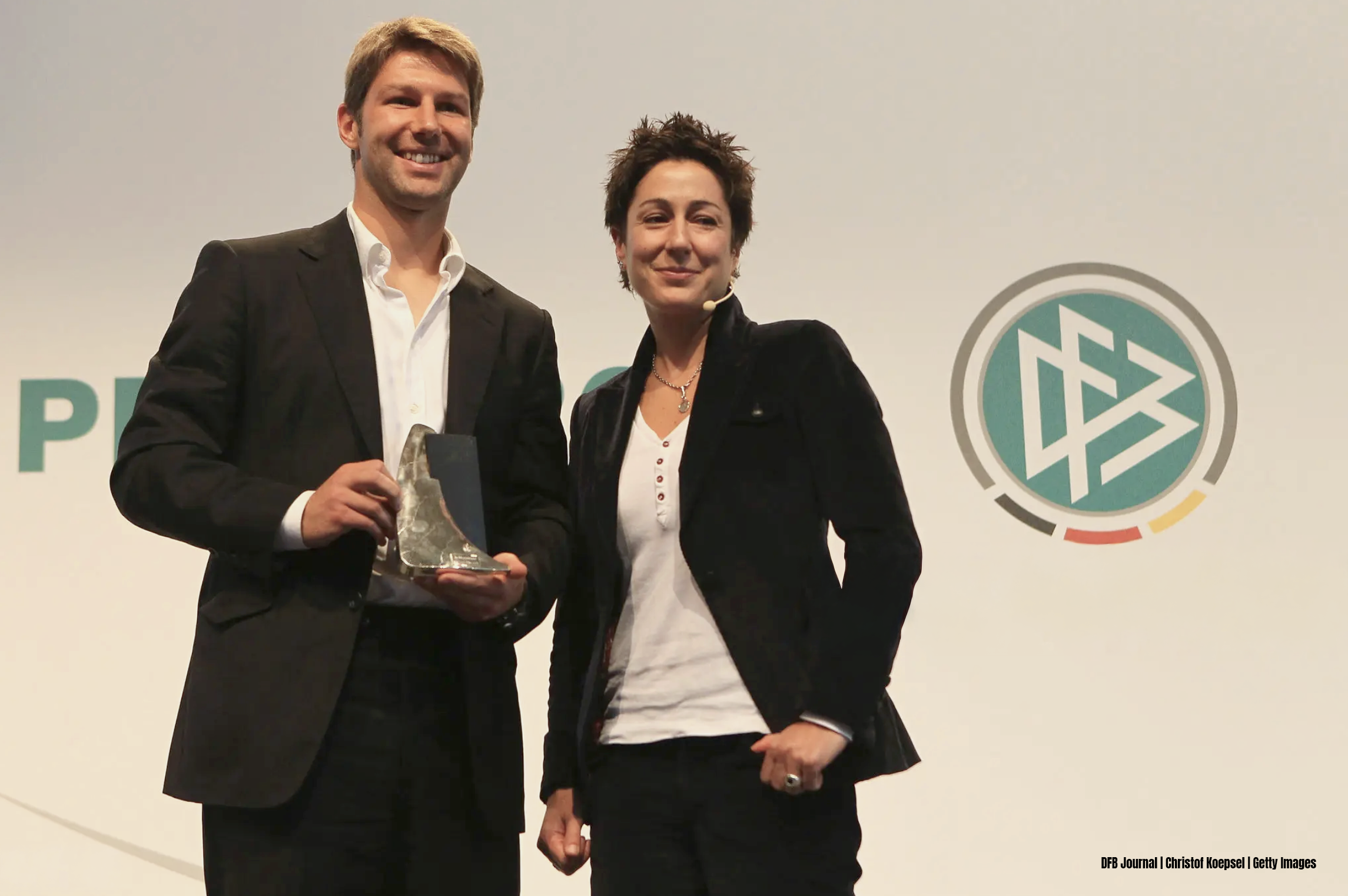
Image | DFB Journal, Christof Koepsel, Getty Images
In 2011, Thomas Hitzlsperger received the Julius Hirsch Award for his articles in "Störungsmelder", one of the most significant accolades of his career. Shortly after the end of his playing days, he became the first professional German footballer to come out as gay. In this piece, the 43-year-old writes about the Julius Hirsch Award, the aftermath of his coming out, and how important and valuable football’s commitment to diversity and against racism, anti-Semitism, and homophobia is.
Words can change the world, for better or for worse, in big ways and in small. This has been the case for me as well—again and again, it was words. And every time they were spoken or written down, something good came of it. This story also starts with words, unfortunately, terrible ones. I was a young player when DIE ZEIT asked me whether I could imagine being part of the writing team for "Störungsmelder". I wasn’t immediately sure whether I wanted to expose myself in this way. Taking a stance on a blog against anti-Semitism and far-right extremism is something one has to feel confident about, especially as a footballer who had yet to prove himself on the pitch. But it intrigued me. I had an experience in the back of my mind that had happened before my professional career started. When I was a trial player at Celtic Glasgow, we played a friendly match in Germany as part of our pre-season preparations. During this game, my dark-skinned teammate was racially abused—severely and repeatedly. These were ugly words, hateful words, and words that went unchallenged. It was incomprehensible to me that something like this could happen—and even more shocking that there were no consequences. Shrugging it off—that’s just how it is. The memories of that experience drove me to accept the invitation and start writing for "Störungsmelder". Because I believe: That’s not how it is!
For me, the challenge in writing wasn’t so much about the content, but more about the craft of it. I had to teach myself how to write and formulate my thoughts, and at times, I struggled with it. But I often felt that it was worth the effort, and that I succeeded in conveying what I wanted to express. My experience as a writer for "Störungsmelder" wasn’t entirely positive. Not everyone liked what I wrote; not everyone was happy that I was engaging in this area. There were quite a few hateful comments, and honestly, the backlash affected me. I often hear people claim that they aren’t bothered by criticism or insults, that they don’t read them, and if they do, they aren’t affected by them. But for me, I must say: I care. I read the words. They affect me. At least, that’s how it was back then.
These days, personal insults don’t bother me, especially when it comes to my sexual orientation. I’ve reflected on myself long enough, and I’m very clear on this matter. Perhaps I radiate that confidence, because frankly, this kind of thing doesn’t happen anymore. When it comes to topics like anti-Semitism and racism, however, it’s different. I’m white, and I’m not of Jewish faith. The hatred isn’t aimed at me personally, but it still affects me because it targets people I want to stand up for.
In 2011, when I was awarded the Julius Hirsch Honorary Prize for my contribution to "Störungsmelder", it was a gratifying confirmation and valuable recognition for me. But the award was also a responsibility to stand by my words, to keep going, and to not lessen my commitment. I don’t remember the details of the event, but I can say that the Julius Hirsch Prize is one of the most valuable trophies of my career—it is prominently displayed. Because it goes beyond sport, because it doesn’t reward something I have talent for, but rather, it is based on my character, my values, and my beliefs. And on standing by them. That means a lot to me, even more so today than back then. Because anyone who knows my history understands that this was a process that wasn’t fully complete in all areas back in 2011.
Today, I can talk about my homosexuality without any hesitation. But in 2011, I didn't have that ability. When I look back to those times, including the two or three years that followed, my feelings are mixed. I wasn’t doing well back then, especially when I was in Rome playing for Lazio. The move to Italy was supposed to be a fresh start after my time at VfB Stuttgart. But it didn’t work out. It was the time when I could no longer run away from the fact that I was attracted to men. The more I became aware of my orientation, the stronger the need grew to end the hiding and publicly acknowledge my homosexuality. I wanted to speak the words.
The answer to the question of why I didn’t come out while I was still playing is multifaceted. One aspect is my performance on the field. I was no longer one of the key players. And a coming out should come from a position of strength—that was my belief. These thoughts reflect an attitude that is still often echoed today. Comments from football officials about potential coming outs often go in this direction: “I don’t have a problem with it—as long as he plays good football.” That’s wrong—being gay doesn’t have to correlate with good performance. But there were other thoughts that held me back from coming out at the time. For example, the fear that the expected headlines, the attention, and the upheaval would have a negative impact on the team. I didn’t want to put my own well-being above the success of the club.
Still, at some point during my playing career, I had reached a point where I was almost ready. I wanted to speak out, I wanted to be able to live and love openly and on my own terms. But experts advised against it, so I took that step much later. There was a time when I regretted not doing it sooner. Because if I had come out while I was still active, there would now be an example. But now I see it more nuanced. The people who advised me back then probably meant well. Their assessment was that I wouldn’t have been able to bear the weight of it, that I wouldn’t have been able to handle the pressure and the attention. Today, I have these thoughts: What if they were right? Then there would be an example of an active player coming out—but it would have been a negative one.
I also don’t think my coming out has any stigma because it happened after my career. When I think about the effects of taking a public stand, a lot of what I hoped for has come to pass. I still clearly remember the final months of my career. I wasn’t feeling comfortable, I wasn’t playing well, I was dissatisfied. Everything seemed to come together, to overlap and feed into each other. Even my love for football suffered. At that point, football wasn’t just the wonderful game it had been for me. It was also the thing that held me back, that kept me from living freely, or so I thought back then.
When the words were finally spoken, the response was almost entirely understanding, support, and appreciation. It felt good, and from that moment on I was able to shape my life free of worry. Of course, there is also another perspective — the one that asks what has changed in society, and why there are still no successors, no active Bundesliga players who openly identify as gay. I ask myself that question too, and I have only partial explanations. Looking at developments in Germany and around the world, I see many things that give me cause for concern. But specifically in the areas of homophobia and diversity, I also see a lot of positive change. Rainbow symbols are now a normal part of football. Associations and clubs are committed to diversity and against discrimination; there are gay fan clubs. Playing rights for trans*, intersex, and non-binary people have been introduced; there are visibility campaigns such as the raising of the Pride flag at the DFB campus. And I can say this: I feel completely comfortable in the football world; I don’t sense prejudice or reservations.
But the truth is that football internally is not yet as far along as it claims to be externally. This applies on the one hand to the dressing room, and on the other to clubs and associations. When sporting and financial success are at stake, one must unfortunately admit that public commitments are sometimes merely lip service. And yet: every sign in favour of diversity has value. Because if we don’t make visible statements, we leave the stage to the loudmouths. Symbols help to establish an attitude that does not tolerate discrimination — and that is worth a great deal. I believe: every initiative for diversity and against racism and homophobia is important, and the Julius Hirsch Award is an outstanding signal, one that I know is noticed. When I look at the list of award winners from the past 20 years, I feel, firstly, gratitude and, secondly, great admiration. Not only for the prize winners, but also for everyone who gets involved. The more people who do this work, and the bigger the stage their actions receive, the greater the effect. The shouters shout because they are afraid; they sense that they are in the minority, perhaps even that they are in the wrong, and they shout to drown out that feeling. It is good when something is set against that noise. If I have just written that football is not yet where it ought to be, that does not mean that many parts of football aren’t already there. Supporting those parts, and giving them acceptance and recognition, is extremely valuable. That is exactly what the Julius Hirsch Award has been doing for 20 years now.
One more thing: I am often asked whether I would advise gay players to come out. That can’t be answered in general terms, because it depends primarily on the individual’s personality — how grounded they are, how confident, how courageous. But fundamentally, I think we often take the wrong approach. We think in terms of dangers, focus on risks, and lose sight of what can be gained, what opportunities exist. I have gained something that could not be bigger or more significant: freedom and independence. Just as important: my self-worth has increased. And crucially: by living openly as a gay man, I am now part of a worldwide, truly wonderful community. There are so many great encounters I would not have had, so many valuable people who would not now be part of my story and my life. All of this is a huge enrichment, and I would not want to miss any of it.
I also know that I have made a difference in small ways. From time to time, people thank me and tell me how much my story has strengthened and reassured them. Such a moment happened just a few weeks ago. A person approached me, looked at me, and tried to place where they knew me from. Then they hesitated and said, “Now I know who you are.” They paused — and then gave me the greatest compliment one human being can give another with words: “It’s good that you exist.”